

Redea Institute International Conference Affirms the Role of Schools as Guardians of Sustainability and the Future


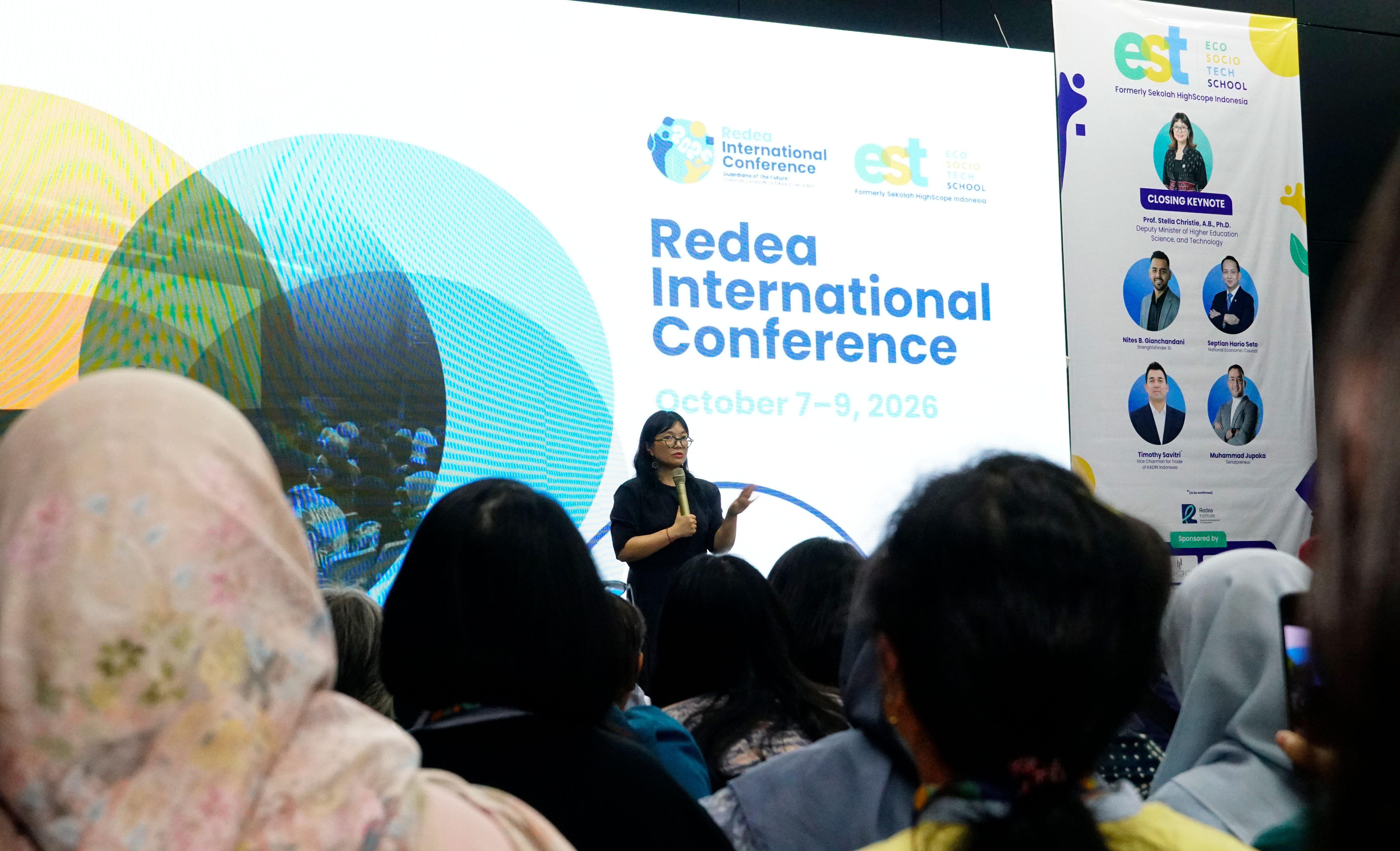
Redea Institute (formerly HighScope Indonesia Institute) emphasizes that schools play a strategic role not only in preparing students for the future but also in building a sustainable, resilient, and prosperous world. Amidst the rapid development of technology and environmental as well as social dynamics, education is challenged to produce a generation that is innovative, adaptive, and cares for others and the environment.
Addressing these challenges, Redea Institute, which oversees the EcoSocioTech (EST) School network (formerly Sekolah HighScope Indonesia), hosted the 16th Redea International Conference on October 8–9, 2026. Carrying the theme “Guardians of the Future: Sustainably Impactful and Future-Driven School,” the conference brought together national and international experts to discuss the transformation of schools into learning ecosystems oriented toward sustainability, innovation, and human well-being.
The international speakers in attendance included Aaron Eisberg from Friends of New Tech (FONT), Napa, California; Richard Cash; and Ken Moore. The conference also featured government representatives and education practitioners to enrich the dialogue on the challenges and opportunities in building education relevant to future needs.
In her opening remarks, Antarina S.F. Amir, Founder and CEO of Redea Institute, highlighted the importance of maintaining a balance between technological advancement and human values.
“As educators, we are the guardians of our students' curiosity and humanity. Our responsibility is to ensure that as technology advances, schools remain grounded in a deep vision of sustainability—an ecosystem where evidence-based decision-making, continuous teacher development, and student agency mutually reinforce academic excellence and human well-being,” said Antarina. “A sustainable school is a living ecosystem that continuously learns, adapts, and evolves so that technology has a clear purpose: shaping resilient, creative, and empathetic individuals.”
An environmental perspective was also shared by Dr. Edward Nixon Pakpahan, ST, M.Sc, Ph.D., Director of Air Quality Protection and Management at the Ministry of Environment/Environmental Management Agency (BPLH), who served as a keynote speaker during the opening session. “Improving the environment is an urgent need that cannot be delayed. As mandated by the 1945 Constitution, Article 28H paragraph (1), everyone has the right to live in physical and spiritual prosperity, to have a home, and to enjoy a good and healthy environment... therefore, collaboration among the government, academics, the business sector, communities, and the public is the key to success,” he stated.
In line with this, Redea Institute encourages the integration of environmental awareness into the school curriculum, culture, operations, and governance. Sustainability is viewed holistically,
encompassing ethical leadership, the responsible use of technology, organizational resilience, and student empowerment.
As the closing speaker, the conference featured the Deputy Minister of Higher Education, Science, and Technology, Stella Christie, who rounded out the series of discussions on the future of education, science, and technology. In her presentation, she revealed data from the OECD (2026) showing that students who use AI every day or almost every day have the lowest average science scores compared to those who never or almost never use AI. According to Stella, if AI alone solves problems, summarizes, and structures information, humans will lose out on the learning process. Furthermore, World Economic Forum (2025) data indicates that agility, consistent learning, and creativity are the primary skills most needed by 2030. “Teachers should not merely teach how to use AI, but teach so that the students' position in the future cannot be replaced by AI. We must be able to critically evaluate the results generated by AI,” she asserted.
In addition to the main sessions, the conference featured "Learning Heroes," a best-practice sharing session by educators from the EST School network. Selected teachers from early childhood (PAUD), elementary (SD), junior high (SMP), and high school (SMA) levels presented innovative teaching strategies and classroom action research results. This initiative reflects Redea Institute's commitment to strengthening educator competencies and fostering collaboration to provide relevant, meaningful, and genuinely impactful learning experiences.
Through the 16th Redea International Conference, Redea Institute reaffirms its commitment to driving schools to become continuously learning and adapting ecosystems, while shaping a generation capable of making tangible contributions to human and environmental sustainability.
